
HWA-HSIA

Company News
21st century Glass Packaging Design - redefining in modern era
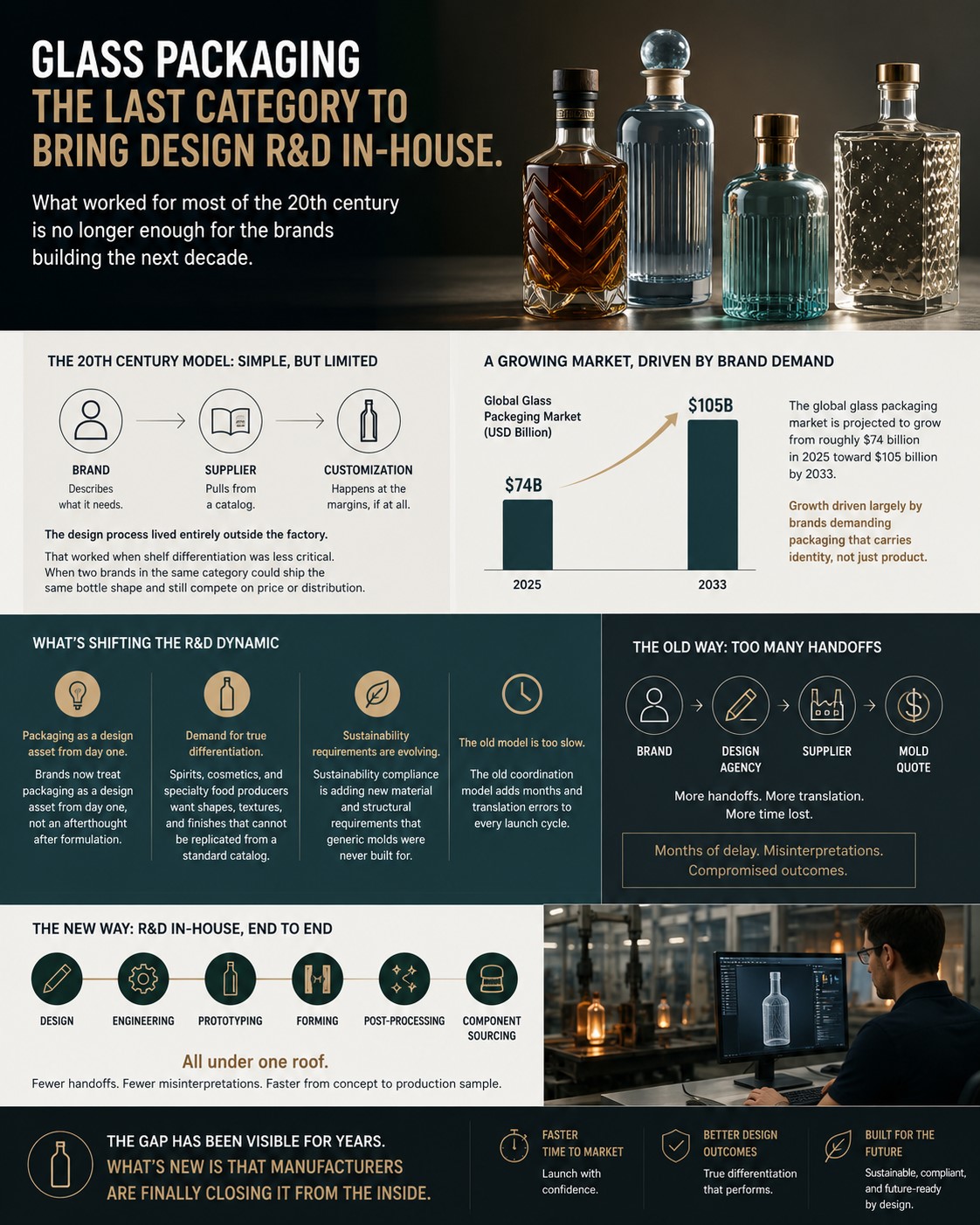
Glass packaging was one of the last manufacturing categories to bring design R&D in-house.
For most of the 20th century, the model was simple.
A brand would describe what it needed.
A supplier would pull from a catalog.
Customization happened at the margins, if at all.
The design process lived entirely outside the factory.
That worked when shelf differentiation was less critical.
When two brands in the same category could ship the same bottle shape and still compete on price or distribution.
That era is ending.
The global glass packaging market is projected to grow from roughly $74 billion in 2025 toward $105 billion by 2033.
Growth driven largely by brands demanding packaging that carries identity, not just product.
What's shifting the R&D dynamic:
Brands now treat packaging as a design asset from day one, not an afterthought after formulation.
Spirits, cosmetics, and specialty food producers want shapes, textures, and finishes that cannot be replicated from a standard catalog.
Sustainability compliance is adding new material and structural requirements that generic molds were never built for.
And the old coordination model — brand briefs a design agency, agency hands off to a supplier, supplier quotes a mold — adds months and translation errors to every launch cycle.
Manufacturers with in-house R&D teams are collapsing that chain.
Design, prototyping, forming, post-processing, and packaging component sourcing happening under one roof means fewer handoffs, fewer misinterpretations, and faster paths from concept to production sample.
The gap between what brands want and what traditional glass suppliers can deliver has been visible for years.
What's new is that manufacturers are finally closing it from the inside.
 Back
Back